
In 1989 I went to India for a three-week intensive with B.K.S. Iyengar and his daughter, Geeta. Mr. Iyengar had just turned 70, and Geeta was officially handling the majority of teaching duties. However until the last week of the intensive, B.K.S. appeared every day and taught much of every class. During the last week, he traveled out of town to teach a class for one day. So Geeta taught solo that day.
Because most of us were preparing to board a plane for the long trip home, Geeta led a class she hoped would prepare us for flight. The class was uncharacteristically mellow. The class was so relaxed that when Geeta ended it without Savasana (Final Relaxation), I felt completely—surprisingly—clear and at ease.
I had experienced Savasana-free classes with American teachers before. Without fail, I felt jagged and edgy after such classes. But Geeta sequenced this class sequenced with the parasympathetic nervous system in mind. For the first—and only—time in my 40 years of yoga practice, no Savasana was needed.
Why Focus on Sequencing Yoga Poses?
Asana (the physical practice), has evolved over the centuries as a way to create a supportive physical environment for the mind to become quiet. Asana practice helps us turn from the sympathetic (fight or flight) to the parasympathetic (rest and digest) aspect of the autonomic nervous system. This creates a supportive environment for meditation.
While each pose has an inherent specific effect on our body/mind, these effects are mutable. The way we approach the practice, and the way we sequence yoga poses can influence the effect on our nervous systems.
To be clear, as I write about sequencing I’m not referring to choreographing a vinyasa flow class. (Although if you teach vinyasa, you could draw on these principles.) Rather, I’m writing about creating an arc that includes a balance of active and passive, heating and cooling, stimulating and calming qualities. One pose leads to and feeds the next based on its physiological effects.
At the end of a practice, my hope is that each person feels clear, energized and at ease, not simply exhausted from a workout. And as a teacher who has not yet acquired Geeta’s sequencing wisdom, I end every practice with a nice, long Savasana of at least 15 minutes.
Sequencing with Asana Qualities in Mind
Each asana has multiple characteristics to consider when I think about how to place it within a sequence. Here are a few of the questions that I ask myself as I move through a sequence:
- Is this pose heating or cooling?
- Does this pose promote stability or mobility?
- Do I intend for this sequence to lead to a particular challenging pose or set of poses? If so, which asanas, in what order, will lead my students to the most easeful expression of the more challenging ones?
- What poses do we have time for, considering that I want to make sure there is plenty of cool-down time before Savasana?
What do heating and cooling mean in terms of asana practice? Poses that are heating stimulate the nervous system and generate internal heat. Many standing poses, backbends, core poses (including arm balances) and some inversions are considered to be heating.
Poses that are cooling calm the nervous system and cool the core. Savasana, forward bends, seated twists, some inversions and even some standing poses are cooling. Both types of poses are essential for a balanced practice.
Sequence Yoga Poses to Build on One Another
When sequencing yoga poses, I like to begin with warm-up poses that gently mobilize the spine and joints. Then I move progressively from less heating or challenging poses to more heating or challenging poses. I leave at least the final third of a practice, sometimes more, for cooling poses, moving from less cooling to more cooling so that my students can slide easily into Savasana.
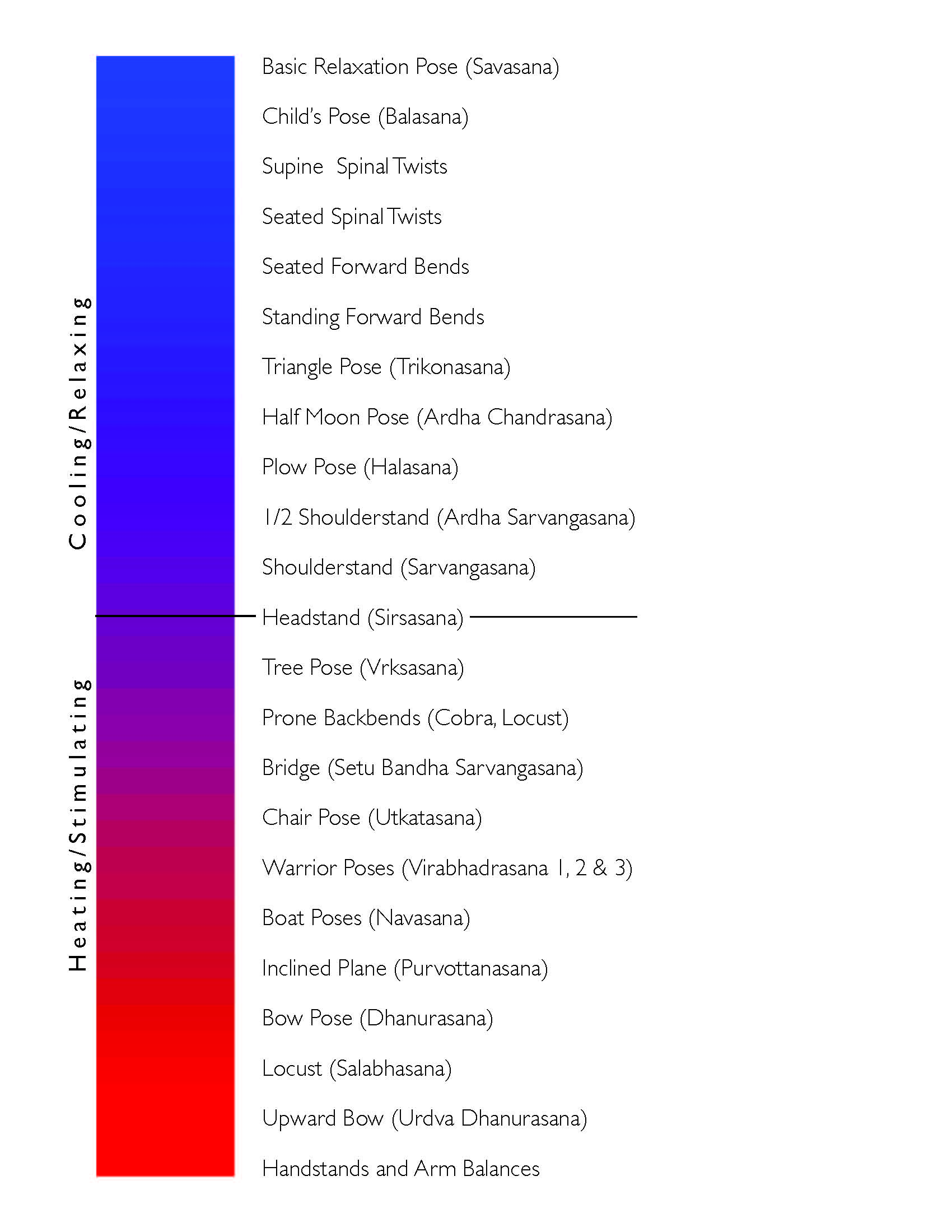
During Geeta’s Savasana-free class, she talked at length about how, even though each pose has inherent heating or cooling effects, the intention with which we approach each pose influences its effect on our body/mind. If we approach heating poses with an attitude of calm and curiosity, we can temper the heating effects. If we approach cooling poses with forcefulness or ambition, they can heat instead of cool. For example, in the graphic Sirsasana (Headstand) appears in the center. While Headstand may be inherently neutral, your comfort level, the quality of your effort and ease of intention can temper the effect.
The above graphic is adapted from a chart authored by Richard Miller. Of course, there are many more poses than appear on the chart, but you can use the examples to represent the various classes of poses. I hope this chart will be helpful in sequencing your personal practice or your classes if you are a teacher.
The wisest way to approach sequencing yoga poses for the most balancing effect is to practice mindfully on your own. Here, your intention is not on accomplishment of poses, but on the present experience of each pose. While the science of sequencing can be taught, the art of sequencing arises out of mindful exploration.